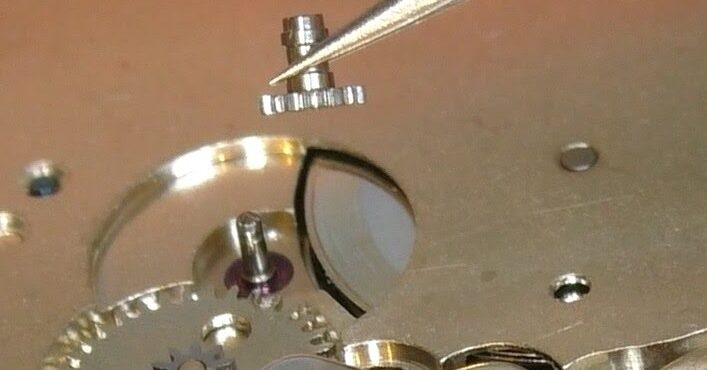
If you’ve ever had a mechanical watch that runs… but somehow can’t keep time (or its hands mysteriously stop moving around midnight), there’s a good chance you’ve met the villain of the story:
The cannon pinion.
It’s small, easy to overlook, and absolutely essential. In fact, you can think of the cannon pinion as the translator between the movement’s gear train and what you actually see on the dial.Let’s break down what it does, how it fails, and what a proper service looks like.
What Is a Cannon Pinion (and Why Does It Matter)?
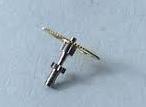
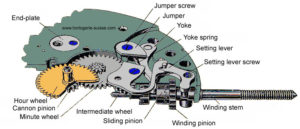
The cannon pinion sits at the center of the motion works—the system that turns the power coming from the gear train into the rotating hands on the dial side.
Here’s the key idea:
- The center wheel drives the motion works.
- The cannon pinion is friction-fit onto the center wheel.
- The minute hand mounts directly onto the cannon pinion.
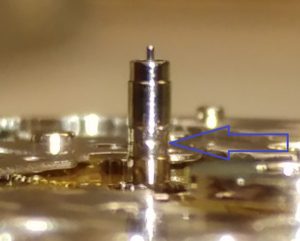
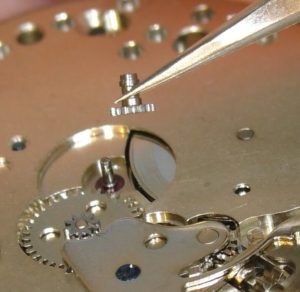
That friction fit is the magic. It has to be tight enough to move the hands reliably, but not so tight that setting the time becomes harsh or risks damage. On many cannon pinions, you’ll see a slight indentation – that subtle “pinch” is part of what creates the friction against the center wheel.

Common Service Step: Removing the Cannon Pinion
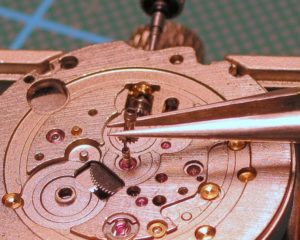
During a routine mechanical service, the cannon pinion may need to come off for cleaning, inspection, lubrication, or replacement.
A fast (and common) method is simply carefully prying it off using quality tweezers. The emphasis is on carefully: the dial-side components don’t forgive slips, and distortion here can create a whole new set of problems.
The #1 Problem: A Cannon Pinion That’s Too Loose
A loose cannon pinion is one of those issues that makes a watch owner feel like they’re losing their mind.
Symptoms You’ll Notice:
- The watch runs, but it loses a lot of time in a normal day.
- On watches with a date complication: it may keep time fine… until it approaches midnight.
Here’s what’s happening when the date is about to change:
- More wheels engage.
- Additional force is needed to push the date ring forward.
- The mechanism has to overcome a click spring (which resists movement by design).
If the cannon pinion friction is weak, it can’t hold firm under that extra load, so the movement keeps running, but the hands stop advancing.
Your watch is technically alive… it just can’t move its arms.
How Watchmakers Tighten a Loose Cannon Pinion
There are a few established methods, and the best approach depends on the movement and the condition of the part.
Common Tightening Options
- Staking set + punch: gently tapping at the indentation point to increase friction
- Purpose-built tightening tools: specialty tools designed to close the gap just enough
- Careful controlled squeezing: a simple method many watchmakers rely on (when done with skill)
A Practical Approach – Squeezing the Pinion
One reliable method involves gently squeezing the pinion at its friction points:
- Insert a small metal rod through the pinion (an old oiler works well) to prevent over-compression.
- Identify the two indentation/friction points on opposite sides.
- Apply very slight pressure with cutters made for this kind of controlled squeeze.
- Reinstall and test how it feels during hand-setting and under load.
This is one of those repairs where precision tools help—but experience matters more. There isn’t a magic measurement; it’s learned through repetition.
There’s an old shop truth that sums it up perfectly:
“A little bit more, a little bit more… oops, too much.”
The goal is to stop before the “oops.”
The Takeaway: Small Part, Big Consequences
A properly functioning cannon pinion is the difference between:
- a movement that runs and displays time correctly, and
- a movement that runs while your hands (literally) stop doing their job.
If your watch is losing time drastically, or your date watch keeps “freezing” around midnight, the cannon pinion is one of the first places a watchmaker will look, and for good reason.

CHARLEY PHOTO OF THE WEEK: Charley and Tom took a few days off for Thanksgiving and are slowly getting back into the watch repair groove this week.